欢迎阅读 PREP-SHOT 文档
- 作者
Zhanwei Liu (liuzhanwei@u.nus.edu), Xiaogang He (hexg@nus.edu.sg)
- 贡献者
Bo Xu (xubo_water@dlut.edu.cn), Jingkai Xie (jingkai@nus.edu.sg), Shuyue Yan (shuyue.yan@u.nus.edu) , Zhouyan Li (zhouyan@nus.edu.sg), Quan Yuan (quanyuan@nus.edu.sg), Kewei Zhang (kewei_zhang@u.nus.edu), Yaozhong Cui (cuiyaozhong@u.nus.edu), Ruiqi Li (li.ruiqi@u.nus.edu), Haixing Gou (gouhaixing@u.nus.edu)
- 所属机构
- 版本
latest
- 日期
2026 年 08 月 13 日
- 版权
The model code is licensed under the GNU General Public License 3.0. This documentation is licensed under a Creative Commons Attribution 4.0 International license.
概述
PREP-SHOT (Pathways for Renewable Energy Planning coupling Short-term Hydropower OperaTion) 是一个透明、模块化的开源能源扩展模型,为能源系统与输电网络的多尺度、跨时段、低成本扩展规划提供先进解决方案。
本模型相较于现有能源扩展模型,对水电运行过程的刻画更深入。urbs 等模型可能将水电视为固定过程,而 GenX、PLEXOS 等模型可能无法充分体现水头的动态特性、或者将多座水电站合并为一个机组。PREP-SHOT 专为弥补这些不足而设计。
本模型显式考虑电站级的水头动力学 (即随时间变化的水头与库容) 与区域电网中所有水电站的系统级网络拓扑,因此能够更准确地反映水电运行与能源系统扩展之间的多尺度动态反馈。此外,它能够真实模拟水电出力的总量与时空变化,在梯级水电站众多的区域尤为有效。
借助 PREP-SHOT,我们致力于回答未来能源规划与利用方面的关键问题:
如何在深度不确定性下有效规划能源组合与新增输电容量?
如何量化水电出力波动对未来能源组合中发电量与装机容量的影响?
工作原理
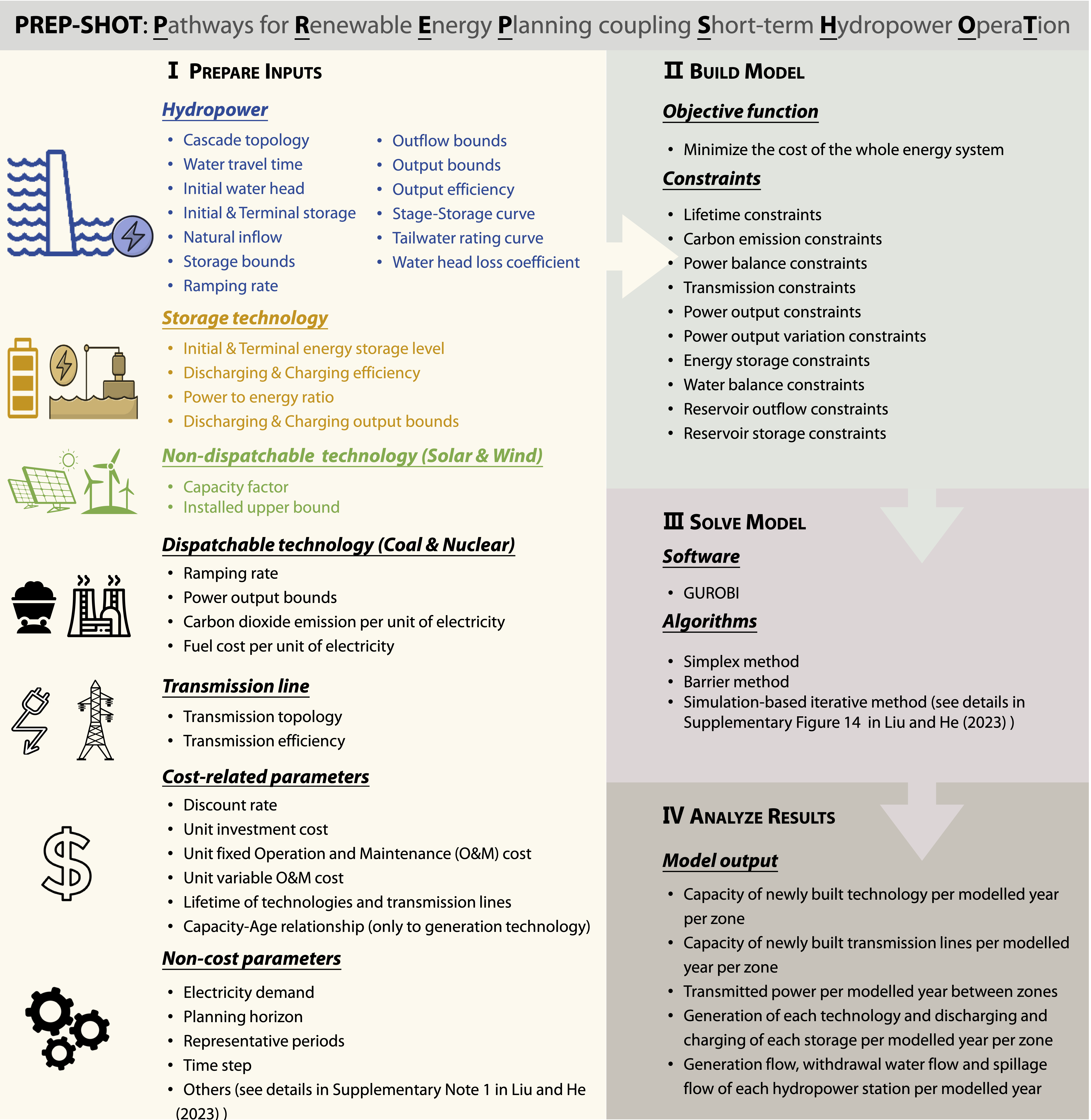
Source: Liu and He (2023).
核心特性
New to power-system modeling?
Four free primers we recommend reading alongside PREP-SHOT:
Power Sector Modeling 101 (US DOE EPSA, 2016) -- the model families PREP-SHOT belongs to and where their assumptions break.
Beginner's Guide to Understanding Power System Model Results for Long-Term Resource Plans (NREL, 2023) -- how to read a capacity-expansion result.
Advanced Guide to Understanding Power System Model Results for Long-Term Resource Plans (NREL, 2024) -- deeper sequel: reliability metrics, reserve margin, transmission congestion.
Electric Grid and Markets 101 (NREL, 2024) -- how the bulk power system actually works: generation, transmission, ISOs/RTOs, day-ahead vs real-time markets, ancillary services. Real-world grounding for the modeled abstractions.
Validation benchmarks
PREP-SHOT ships three independent benchmarks that compare the model's output against externally-published reference numbers. Each benchmark stands alone, with its own input data, notebook walking through the validation, and pytest regression:
PJM 5-bus -- Hogan / MATPOWER
case5: 5 buses, 5 generators, single-hour DC OPF. PREP-SHOT reproduces MATPOWER'srunopftotal cost ($17,479.89) to the dollar and the dispatch to 0.01 MW.IEEE RTS-79 -- 24 buses, 32 generators, full hourly load profile (8 736 hours). Annual energy by carrier matches the merit-order benchmark; peak-hour dispatch matches the textbook pattern (hydro 300, nuclear 800, coal 1 274, oil 476 MW).
IEEE RTS-96 -- 3-area extension of RTS-79 (73 buses, 96 gens, 5 inter-area ties). Validates the multi- area DC OPF: each area's dispatch is exactly 3 x RTS-79.
Cambodia -- must-take port of the Cambodia case from PowNet (Chowdhury et al. 2020): 18 thermals + 6 hydros + 3 imports, 8 760 hours. PREP-SHOT thermal+import total matches PowNet's published 3.90 TWh within 0.3 %.
Laos -- companion hydro-export case (5 thermals + 30 hydros + 4 imports). Validates the structural pattern of a hydro-dominated system (hydro share ~80 %).
Germany -- PyPSA's single-day Germany example (Brown et al. 2018; SciGRID open-data network with 1 423 generators across 585 buses). PREP-SHOT lands on EUR 4.72 M for the 24-hour cost-minimising dispatch, inside PyPSA's published EUR 4-5 M range.
离线文档
如需离线阅读,可在 Read the Docs 上下载 HTML 压缩包 (也可通过每页左下角的版本切换器访问)。