Southeast Asia (Lower Mekong, 5 zones, CEM)
A walkthrough of the Southeast Asia case study that ships with PREP-SHOT: capacity expansion across 5 countries (Cambodia, Laos, Myanmar, Thailand, Vietnam) from 2020 to 2030, with 57 cascading hydropower stations in the Mekong basin and a system-wide carbon cap of 146 MtCO2 in 2030.
This notebook complements the Quickstart. The Quickstart uses a small synthetic 3-zone dataset and walks through running a solve in 5 minutes; this tutorial focuses on a realistic dataset – understanding its structure, exploring the demand and existing fleet, and pointing you at the commands to run a full multi-zone, multi-year capacity-expansion solve.
Run online: Open in Colab – click and run.
Run locally:
git clone https://github.com/PREP-NexT/PREP-SHOT.git
cd PREP-SHOT
pip install -e .[notebook]
jupyter lab examples/southeast_asia/SoutheastAsia.ipynb
What this tutorial covers:
The Lower Mekong scenario in plain English
Demand profiles by country
The existing 2020 fleet – conventional, storage, and hydro
Per-station hydropower (the feature that distinguishes PREP-SHOT from PyPSA / GenX)
Inter-country transmission topology
How to run a full capacity-expansion solve on this dataset
What this case study reveals that aggregated models would miss
[1]:
# On Google Colab, install PREP-SHOT and clone the repo. No-op on
# Local installs already have prepshot importable.
try:
    import google.colab  # type: ignore  # noqa: F401
    IS_COLAB = True
except ImportError:
    IS_COLAB = False

if IS_COLAB:
    import os
    if not os.path.isdir('/content/PREP-SHOT'):
        !git clone --depth=1 https://github.com/PREP-NexT/PREP-SHOT.git /content/PREP-SHOT
    %cd /content/PREP-SHOT
    !pip install --quiet matplotlib pandas
[2]:
import pathlib

# Walk up from cwd to find the repo root (the dir with run.py),
# then point SEA_DIR at examples/southeast_asia/input/. Works
# whether the kernel is launched from the repo root, from
# examples/southeast_asia/, or from anywhere in between.
repo_root = pathlib.Path.cwd()
while not (repo_root / 'run.py').exists():
    if repo_root == repo_root.parent:
        raise RuntimeError(
            'Could not find PREP-SHOT repo root; run this notebook '
            'from a checkout of PREP-NexT/PREP-SHOT.'
        )
    repo_root = repo_root.parent
SEA_DIR = repo_root / 'examples' / 'southeast_asia' / 'input'
print(f'Repo root: {repo_root}')
print(f'Dataset:   {SEA_DIR}')
Repo root: /Users/energy/01-doing/PREP-SHOT-tutorial/PREP-SHOT
Dataset:   /Users/energy/01-doing/PREP-SHOT-tutorial/PREP-SHOT/examples/southeast_asia/input
1. The scenario
The Lower Mekong basin spans five Southeast Asian countries with very different power systems:
Cambodia, Laos, Myanmar – small, hydro-dominant, mostly exporters (especially Laos, the ‘battery of Southeast Asia’)
Thailand, Vietnam – large, fossil-heavy, importers
The shared resource is the Mekong river system: 57 cascading hydropower stations whose operation in one country affects downstream flows in another. Adding a coal plant in Vietnam, expanding solar in Thailand, or building a new dam in Laos all interact through the system-wide power balance, the international transmission grid, and – in 2030 – a system-wide 146 MtCO2 emission cap.
PREP-SHOT models this as a single capacity-expansion linear program, picking the least-cost technology mix in each country for each modeled year subject to demand, fuel, transmission, reservoir, and carbon constraints.
2. Demand profiles by country
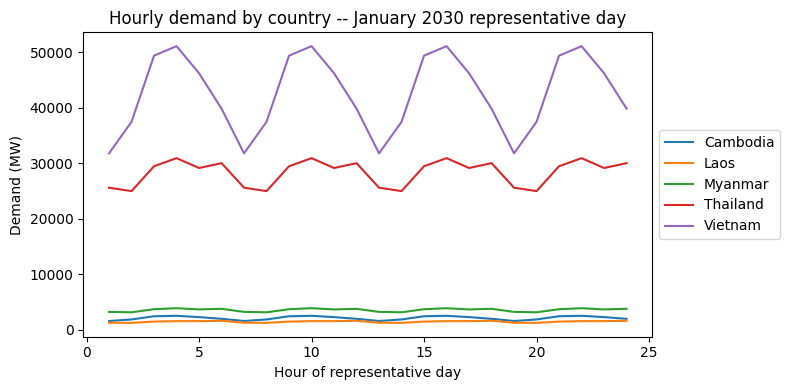
Hourly load shape across the 5 zones. Vietnam and Thailand dominate consumption; Cambodia, Laos, and Myanmar are an order of magnitude smaller. The dataset uses 288 representative hours per month across 12 months, so the chart below shows one representative day’s shape from January 2030.
[3]:
import pandas as pd
import matplotlib.pyplot as plt
%matplotlib inline

demand = pd.read_csv(SEA_DIR / 'demand.csv')
shape = (
    demand[(demand.year == 2030) & (demand.month == 1) & (demand.hour <= 24)]
    .pivot_table(index='hour', columns='zone', values='value')
)

fig, ax = plt.subplots(figsize=(8, 4))
shape.plot(ax=ax)
ax.set_xlabel('Hour of representative day')
ax.set_ylabel('Demand (MW)')
ax.set_title('Hourly demand by country -- January 2030 representative day')
ax.legend(loc='center left', bbox_to_anchor=(1.0, 0.5))
fig.tight_layout()
plt.show()

# Approximate annual demand totals by country and year
annual = (
    demand.groupby(['zone', 'year'])['value']
    .sum()
    .unstack('year')
    .round(0)
)
annual
[3]:
| year | 2020 | 2030 |
|---|---|---|
| zone | ||
| Cambodia | 261445.0 | 607673.0 |
| Laos | 167179.0 | 414307.0 |
| Myanmar | 794647.0 | 1037239.0 |
| Thailand | 6383687.0 | 8332514.0 |
| Vietnam | 6999481.0 | 12535004.0 |
3. The existing fleet (2020)
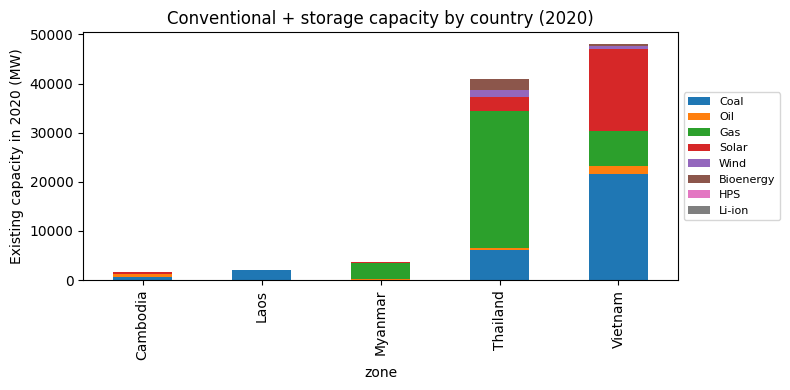
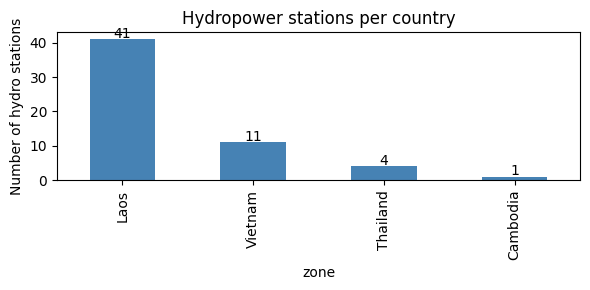
What’s already built. Vietnam dominates with 21.6 GW of coal and 16.7 GW of solar; Thailand has 27.9 GW of gas. The 57 hydropower stations are split across Laos (41), Vietnam (11), Thailand (4), and Cambodia (1) – we’ll handle them separately below.
[4]:
fleet = pd.read_csv(SEA_DIR / 'tech_existing.csv')

conventional = ['Coal', 'Oil', 'Gas', 'Solar', 'Wind', 'Bioenergy',
                'HPS', 'Li-ion']
fleet_conv = fleet[fleet.tech.isin(conventional)]

stack = (
    fleet_conv
    .pivot_table(index='zone', columns='tech', values='capacity',
                 aggfunc='sum', fill_value=0)
    .reindex(columns=conventional, fill_value=0)
)

fig, ax = plt.subplots(figsize=(8, 4))
stack.plot.bar(ax=ax, stacked=True)
ax.set_ylabel('Existing capacity in 2020 (MW)')
ax.set_title('Conventional + storage capacity by country (2020)')
ax.legend(loc='center left', bbox_to_anchor=(1.0, 0.5), fontsize=8)
fig.tight_layout()
plt.show()

stack.round(0)
[4]:
| tech | Coal | Oil | Gas | Solar | Wind | Bioenergy | HPS | Li-ion |
|---|---|---|---|---|---|---|---|---|
| zone | ||||||||
| Cambodia | 675.0 | 644.0 | 0.0 | 237.0 | 0.0 | 31.0 | 0 | 0 |
| Laos | 1978.0 | 0.0 | 0.0 | 0.0 | 0.0 | 0.0 | 0 | 0 |
| Myanmar | 120.0 | 25.0 | 3341.0 | 180.0 | 0.0 | 0.0 | 0 | 0 |
| Thailand | 6114.0 | 369.0 | 27920.0 | 2856.0 | 1486.0 | 2213.0 | 0 | 0 |
| Vietnam | 21554.0 | 1706.0 | 7152.0 | 16656.0 | 582.0 | 365.0 | 0 | 0 |
4. Per-station hydropower
PREP-SHOT’s distinguishing feature is per-station hydropower. Each row in tech_registry.csv with carrier='hydro' is a physical station with its own reservoir, head-discharge curve, and inflow time series. The model tracks water mass balance between cascading stations explicitly. PyPSA, GenX, and similar models aggregate hydropower into a single per-zone tech, losing the cascade physics.
Most stations sit on the Lao Mekong tributaries (the Nam-* series, plus the Xe-Kong, Se-San, Sre Pok cascades extending into Vietnam and Cambodia).
[5]:
stations = pd.read_csv(SEA_DIR / 'reservoir_zone.csv')
stations.columns = [c.strip() for c in stations.columns]
by_zone = stations.groupby('zone').size().sort_values(ascending=False)

fig, ax = plt.subplots(figsize=(6, 3))
by_zone.plot.bar(ax=ax, color='steelblue')
ax.set_ylabel('Number of hydro stations')
ax.set_title('Hydropower stations per country')
for i, v in enumerate(by_zone.values):
    ax.text(i, v + 0.5, str(v), ha='center')
fig.tight_layout()
plt.show()

print(f'Total hydropower stations: {len(stations)}')
print('Sample station names:')
for s in stations.tech.head(8):
    print(f'  {s}')
print('  ...')
Total hydropower stations: 57
Sample station names:
  Nam_Ou_7
  Nam_Ngay
  Nam_Ou_6
  Nam_Ou_5
  Nam_Pok
  Nam_Ou_4
  Nam_Pha
  Nam_Ko
  ...
[6]:
# Each station has reservoir-physics parameters: head, capacity
# bounds, storage bounds, generation efficiency. Sample the
# largest 10 stations by capacity:
head = pd.read_csv(SEA_DIR / 'reservoir_head.csv')
cap  = pd.read_csv(SEA_DIR / 'reservoir_capacity_max.csv')
merged = (
    head[['tech', 'head']]
    .merge(cap[['tech', 'capacity_max']], on='tech')
    .merge(stations[['tech', 'zone']], on='tech')
)
merged.columns = ['station', 'head_m', 'capacity_max_MW', 'zone']
merged.sort_values('capacity_max_MW', ascending=False).head(10).round(1)
[6]:
| station | head_m | capacity_max_MW | zone | |
|---|---|---|---|---|
| 14 | Mekong_at_Xayabuly | 29.0 | 1260.0 | Laos |
| 45 | Yali | 190.0 | 720.0 | Vietnam |
| 17 | Nam_Ngum_2 | 159.5 | 615.0 | Laos |
| 24 | Nam_Theun1 | 130.0 | 600.0 | Laos |
| 41 | Lam_Ta_Khong_P.S. | 360.0 | 500.0 | Thailand |
| 15 | Nam_Ngum_3 | 301.0 | 480.0 | Laos |
| 51 | Lower_Se_San_2 | 28.5 | 400.0 | Cambodia |
| 48 | Se_San_4 | 56.0 | 360.0 | Vietnam |
| 29 | Xe_Kong_5 | 180.0 | 330.0 | Laos |
| 40 | Xekaman_1 | 101.2 | 290.0 | Laos |
5. Inter-country transmission
Existing inter-country transmission capacity (MW). Most flows today route through Laos and Thailand. The transmission candidates table allows any pair to expand.
[7]:
trans = pd.read_csv(SEA_DIR / 'transmission_existing.csv')
trans = trans[trans.value > 0]
matrix = trans.pivot_table(
    index='zone1', columns='zone2', values='value',
    aggfunc='sum', fill_value=0,
)
matrix.round(0)
[7]:
| zone2 | Cambodia | Laos | Thailand | Vietnam |
|---|---|---|---|---|
| zone1 | ||||
| Cambodia | 0.0 | 0.0 | 120.0 | 400.0 |
| Laos | 0.0 | 0.0 | 2205.0 | 248.0 |
| Thailand | 120.0 | 2205.0 | 0.0 | 0.0 |
| Vietnam | 400.0 | 248.0 | 0.0 | 0.0 |
6. Running a full capacity-expansion solve
This dataset is fully self-contained: examples/southeast_asia/ ships its own config.json, params.json, and input/ – exactly the same layout as examples/three_zone/ or examples/thailand/. To run a full solve, treat that directory as the working root:
# from the repo root
cd examples/southeast_asia
python -m prepshot
The shipped config uses 288 representative hours x 12 months at 3 head iterations – the dataset’s native resolution. Expect about 30 minutes on commodity hardware. Drop hour to 24 and month to 1 for a quicker (less accurate) sanity solve. Results land in examples/southeast_asia/output/baseline.nc.
Counterfactual scenarios without overwriting the baseline:
# Tighter 2030 carbon cap: prepare a modified file
cd examples/southeast_asia/input
cp policy_carbon_emission_limit.csv policy_carbon_emission_limit_tight.csv
# (then edit the 2030 row's value column to 80000000)

cd ..   # back to examples/southeast_asia
python -m prepshot --carbon_emission_limit=tight
# results -> output/baseline_tight.nc
PREP-SHOT registers a CLI flag for every params.json key; the flag value is appended as a suffix to the input file name and to the output netCDF. See Model Inputs/Outputs for the full list of overrideable inputs.
7. Post-solve diagnostics: common plots from a solved baseline
Once python run.py finishes, results land in examples/southeast_asia/output/baseline.nc (and .xlsx). The cells below load that file and produce the four plots that answer the most common questions about an expansion-planning result:
Capacity buildout by zone × tech × year: how the fleet evolves
Generation mix by zone × tech: what’s actually serving demand
Emissions vs the cap: whether the carbon constraint is binding
Cost breakdown: where the NPV dollars go
[8]:
import pandas as pd
import matplotlib.pyplot as plt
import numpy as np

# Read from the .xlsx mirror so the cell works without a netCDF4
# build (the .xlsx contains the same numbers as baseline.nc).
OUT = SEA_DIR.parent / 'output' / 'baseline.xlsx'
if not OUT.exists():
    raise FileNotFoundError(
        f'No solved baseline at {OUT}. Run `python run.py` from '
        f'examples/southeast_asia/ first.'
    )
xl = pd.ExcelFile(OUT)
print('Sheets:', xl.sheet_names[:8], '...')
Sheets: ['trans_export', 'gen', 'install', 'carbon', 'charge', 'cost_var_breakdown', 'cost_fix_breakdown', 'cost_newtech_breakdown'] ...
7.1 Capacity buildout
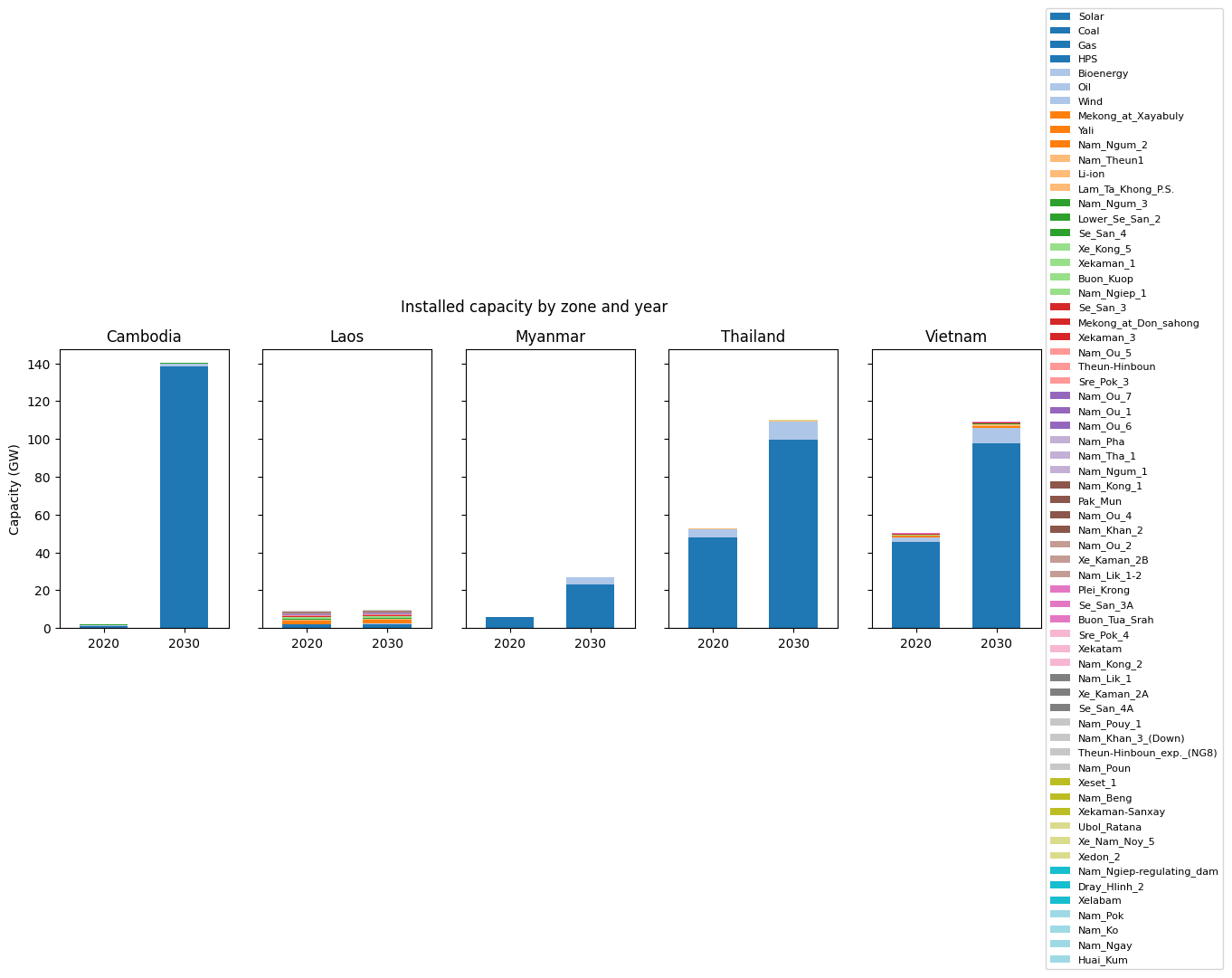
Per-zone stacked bars by technology, comparing 2020 (existing) to 2030 (after expansion). Cambodia’s 2030 column is the most striking — it grows from ~2 GW to ~140 GW because the model uses Cambodia as a renewable-rich exporter to Vietnam and Thailand once the carbon cap binds.
[9]:
inst = pd.read_excel(xl, 'install')
techs_order = (inst.groupby('tech')['install']
               .sum().sort_values(ascending=False).index.tolist())
zones = sorted(inst['zone'].unique())

fig, axes = plt.subplots(1, len(zones), figsize=(14, 4), sharey=True)
for ax, z in zip(axes, zones):
    sub = (inst[inst.zone == z]
           .pivot(index='year', columns='tech', values='install')
           .fillna(0))
    sub = sub.reindex(columns=[t for t in techs_order if t in sub.columns])
    (sub / 1000).plot(
        kind='bar', stacked=True, ax=ax,
        legend=(z == zones[-1]), width=0.6, colormap='tab20',
    )
    ax.set_title(z)
    ax.set_xlabel('')
    ax.tick_params(axis='x', rotation=0)
    ax.set_ylabel('Capacity (GW)' if z == zones[0] else '')
axes[-1].legend(loc='center left', bbox_to_anchor=(1, 0.5),
                fontsize=8, ncol=1)
fig.suptitle('Installed capacity by zone and year', y=1.02)
plt.tight_layout()
plt.show()
/var/folders/y_/ypyrt83d1hl9fhjtt_ftpwg00000gn/T/ipykernel_11433/768360123.py:23: UserWarning: Tight layout not applied. The bottom and top margins cannot be made large enough to accommodate all Axes decorations.
  plt.tight_layout()
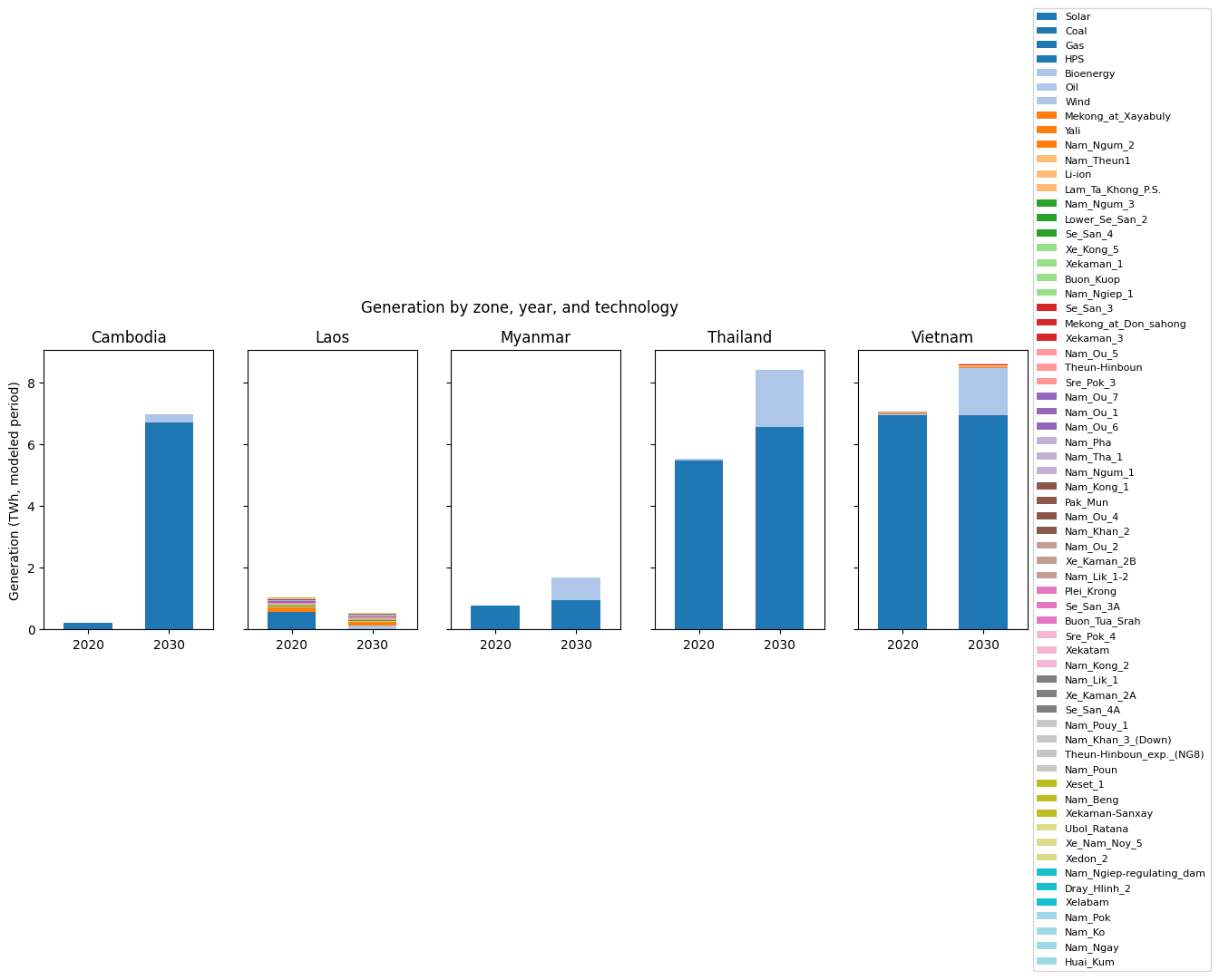
7.2 Generation mix
Same layout, but summing gen over (hour, month) to get annual TWh. The point of the chart: which technologies actually run, vs. which are just installed (peakers may have lots of capacity but very low utilization).
[10]:
gen = pd.read_excel(xl, 'gen')
# gen is keyed by (hour, month, year, zone, tech); aggregate to
# annual TWh per (year, zone, tech).
g_annual = gen.groupby(['year', 'zone', 'tech'])['gen'].sum().reset_index()
g_annual['gen_TWh'] = g_annual['gen'] / 1e6

fig, axes = plt.subplots(1, len(zones), figsize=(14, 4), sharey=True)
for ax, z in zip(axes, zones):
    sub = (g_annual[g_annual.zone == z]
           .pivot(index='year', columns='tech', values='gen_TWh')
           .fillna(0))
    sub = sub.reindex(columns=[t for t in techs_order if t in sub.columns])
    sub.plot(
        kind='bar', stacked=True, ax=ax,
        legend=(z == zones[-1]), width=0.6, colormap='tab20',
    )
    ax.set_title(z)
    ax.set_xlabel('')
    ax.tick_params(axis='x', rotation=0)
    ax.set_ylabel('Generation (TWh, modeled period)' if z == zones[0] else '')
axes[-1].legend(loc='center left', bbox_to_anchor=(1, 0.5),
                fontsize=8, ncol=1)
fig.suptitle('Generation by zone, year, and technology', y=1.02)
plt.tight_layout()
plt.show()
/var/folders/y_/ypyrt83d1hl9fhjtt_ftpwg00000gn/T/ipykernel_11433/428247067.py:24: UserWarning: Tight layout not applied. The bottom and top margins cannot be made large enough to accommodate all Axes decorations.
  plt.tight_layout()
7.3 Emissions vs the carbon cap
The system-wide carbon cap is inf in 2020 (unconstrained) and 146 MtCO2 in 2030. Emissions in 2030 should sit exactly on the cap if it’s binding — that’s how you can tell the constraint is doing work.
[11]:
co2 = pd.read_excel(xl, 'carbon')
co2['carbon_Mt'] = co2['carbon'] / 1e6

cap = pd.read_csv(SEA_DIR / 'policy_carbon_emission_limit.csv')
cap_finite = cap[cap['value'] != float('inf')].copy()
cap_finite['cap_Mt'] = cap_finite['value'] / 1e6

fig, ax = plt.subplots(figsize=(6, 4))
ax.bar(co2['year'], co2['carbon_Mt'], width=2,
       color='#cc4444', alpha=0.7, label='Emissions')
for _, row in cap_finite.iterrows():
    ax.hlines(row['cap_Mt'], row['year'] - 2, row['year'] + 2,
              colors='black', linestyles='--', linewidth=2,
              label='Cap' if _ == 0 else None)
ax.set_xlabel('Year')
ax.set_ylabel('CO2 emissions (Mt)')
ax.set_title('System-wide emissions vs carbon cap')
ax.set_xticks(co2['year'])
ax.legend()
plt.tight_layout()
plt.show()

print(co2[['year', 'carbon_Mt']].to_string(index=False))
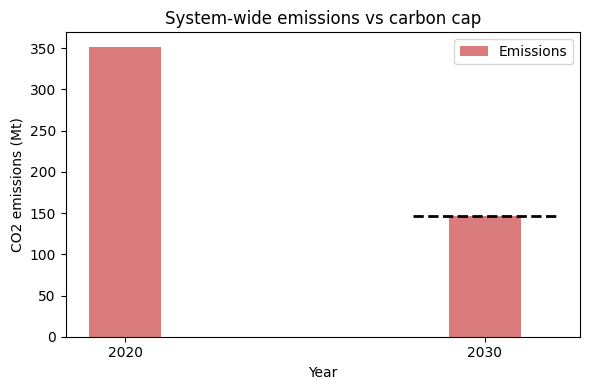
 year  carbon_Mt
 2020 351.715468
 2030 146.000000
7.4 Cost breakdown
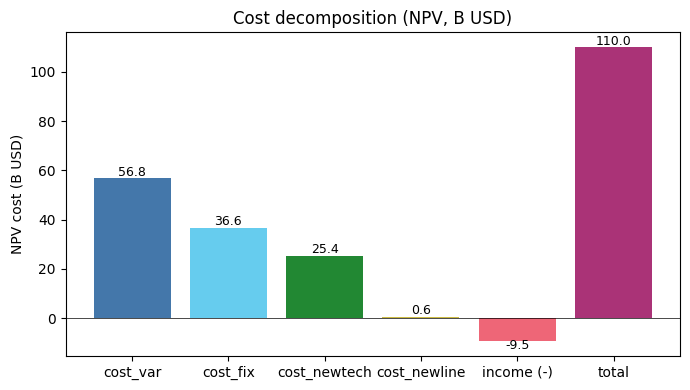
Total NPV cost is the sum of:
cost_var: variable O&M + fuelcost_fix: fixed O&M on existing + new fleetcost_newtech: capex annuity for new generationcost_newline: capex annuity for new transmission−income: water-withdrawal revenue (subtracted from cost)
All values are NPV-discounted to year_min (2020).
[12]:
components = ['cost_var', 'cost_fix', 'cost_newtech', 'cost_newline']
values = [pd.read_excel(xl, c).iloc[0, 1] / 1e9 for c in components]
income = pd.read_excel(xl, 'income').iloc[0, 1] / 1e9
total = pd.read_excel(xl, 'cost').iloc[0, 1] / 1e9

labels = components + ['income (-)', 'total']
vals = values + [-income, total]
colors = ['#4477aa', '#66ccee', '#228833', '#ccbb44',
          '#ee6677', '#aa3377']

fig, ax = plt.subplots(figsize=(7, 4))
ax.bar(labels, vals, color=colors)
for i, v in enumerate(vals):
    ax.text(i, v + (1 if v >= 0 else -3), f'{v:,.1f}',
            ha='center', fontsize=9)
ax.set_ylabel('NPV cost (B USD)')
ax.set_title('Cost decomposition (NPV, B USD)')
ax.axhline(0, color='black', linewidth=0.5)
plt.tight_layout()
plt.show()
8. What this case study shows that aggregated models miss
Three things this dataset reveals that you couldn’t get from PyPSA’s or GenX’s standard hydro abstractions:
1. Cascade interactions across borders. A new dam upstream in Laos changes downstream flow at every station below it – potentially across the Cambodia / Vietnam border. The 57-station model captures this; an aggregated ‘Hydro_Laos’ tech does not.
2. Endogenous water-head dynamics. Each station’s generation efficiency depends on its current reservoir level via the tailrace-discharge and forebay-volume curves. PREP-SHOT’s head-iteration loop solves the LP, recomputes heads from the operational schedule, and re-solves until convergence.
3. Where carbon abatement actually lives. Because the model tracks each zone’s emissions separately under a system-wide cap, the optimization shows where the cheapest abatement is across borders – not just inside each country’s boundary. For the Mekong, the answer is usually ‘don’t build new Vietnam coal; import Lao hydro instead’ – but the optimal trade depends on transmission build cost, hydropower seasonality, and carbon-cap tightness, all of which the model handles endogenously.
Where to next
Quickstart – the simpler 3-zone walkthrough with a full executed solve.
Model Inputs/Outputs – every input and output documented.
Mathematical Notation – the underlying linear program.
Changelog – v1.7 hydropower first-class, v1.8 PyPSA-style behavior flags, v1.9 finance module + LMPs.
If you used PREP-SHOT in published work, please cite it (see the Citation Guide). Issues, discussions, and PRs welcome at github.com/PREP-NexT/PREP-SHOT.